

Modern construction requirements demand not only speed and aesthetics but also maximum durability, safety, and economic efficiency. The answer to these challenges is the technology of prestressing reinforcement — a method that radically changes the approach to creating highly loaded structures. This innovation significantly increases the strength, stiffness, and crack resistance of finished products, making prestressed concrete an indispensable material for projects that require long spans and reduced material consumption.
Unmatched Stiffness: What Is the Essence of the Technology?
The key problem of ordinary concrete lies in its inability to resist high tensile stresses that inevitably occur under load. Prestressing technology solves this problem by creating internal compressive stress in the concrete even before the structure begins operation.
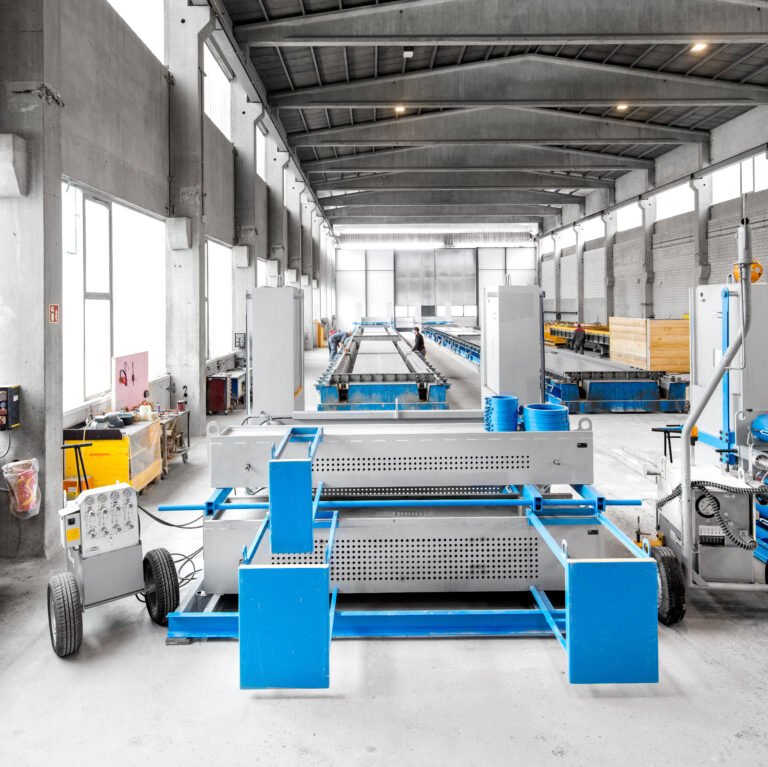
The process is logical and technologically advanced: the reinforcing material (wire or strands) is tensioned in advance using specialized equipment (jacks) to a predetermined level. Then concrete is poured over the stretched reinforcement. After the concrete gains the necessary strength and firmly grips the reinforcement, the tension is released. The force that attempts to return the reinforcement to its original state is transferred to the concrete, constantly compressing it.
This pre-compression fully or significantly compensates for tensile stresses that occur during service loads. At precast concrete plants, reinforcement can be tensioned mechanically (using hydraulic jacks), electrothermally, or by combined electrothermomechanical methods.
From Housing to Industrial Giants: Where the Technology Is Applied
Thanks to its unique characteristics, the technology of prestressing reinforcement is widely used worldwide and in CIS countries for constructing buildings of various purposes. High load-bearing capacity and reliability allow prestressed concrete to be applied where traditional materials fail or become economically ineffective.
Structures produced using this method form the basis of:
- Residential buildings and high-rise complexes.
- Office buildings and business centers.
- Industrial facilities and workshops.
- Warehouses and logistics centers.
- Retail buildings and large hypermarkets.
Economic Benefits and Seismic Safety: Advantages Professionals Choose
Choosing prestressing technology is driven by several critical advantages that ensure long-term project benefits:
- Increased Durability and Stiffness: Prestressed structures have 2–3 times higher resistance to cracking compared to conventional reinforced concrete, guaranteeing extended service life and stability under regular high loads.
- Material Savings: The technology reduces reinforcement consumption by up to 50% and decreases the overall weight of a building by 40%, cutting material use by up to 27%.
- High Profitability: Projects using prestressed concrete show profits exceeding traditional construction methods by up to 35%.
- Architectural Freedom: The versatility of the technology expands architectural and planning capabilities, allowing longer spans and flexible interior layouts.
- Safety: Properly designed structures are more reliable and safer in operation, especially in seismically active regions.
Ensure Reliability: Complete Prestressing Equipment from TDM Engineering
Prestressing technology is not only a concept but also precise and reliable equipment. To fully realize all structural and economic advantages of this method, specialized tensioning systems must be used.
TDM Engineering Oy supplies a full range of high-quality equipment from Paul Maschinenfabrik — from mobile hydraulic stations and high-power tensioning jacks to reliable anchoring grips. We offer time-tested European quality, always available in our warehouse.
Do not risk your project’s quality and budget using outdated methods. Increase the strength of your structures and the profitability of your production today. Contact us for professional engineering consultation and ordering reliable equipment that will become the foundation of your success.
Frequently Asked Questions About Prestressed Concrete (FAQ)
1. What is prestressing technology?
It is the process of creating internal compressive stress in concrete through the preliminary stretching of reinforcement, which increases the strength and crack resistance of the finished product.
2. Why is prestressed concrete needed?
It compensates for conventional concrete’s inability to withstand high tensile stresses that arise under load.
3. How does prestressing work?
The reinforcement is tensioned, concrete is poured, and after it sets, the reinforcement is released. The tensioning force compresses the concrete, preventing tensile deformation and cracking under loads.
4. How much does crack resistance increase?
Prestressed structures are 2–3 times less prone to cracking compared to ordinary reinforced concrete.
5. What are the main advantages of the technology?
Reduced material consumption (up to 50% savings in reinforcement), up to 40% lower building weight, and the ability to cover long spans.
6. Where is this technology used?
It is used in residential, office, industrial, warehouse, and retail buildings, ensuring high reliability.
7. What are the methods of prestressing?
The main methods are mechanical (using jacks), electrothermal (using electric current), and combined electrothermomechanical.