Canada remains one of the world’s most closely watched residential property markets, but in 2026 it is no longer accurate to describe the country as one single housing story. Conditions differ materially between Ontario and British Columbia, the Prairies, Quebec and Atlantic Canada. For a buyer, that fragmentation is useful: it creates room to compare entry prices, liquidity, rental demand, taxes and long-term population fundamentals instead of simply chasing the most famous postal codes.
Homium’s approach is to begin with the buyer’s objective. A family relocating to Canada may prioritize schools, commuting time and housing stability. A permanent resident may focus on mortgage eligibility and long-term ownership. An investor may instead compare rental economics, vacancy risk and the resale depth of a specific neighbourhood. The right property is therefore not “the cheapest” or “the fastest-growing” unit, but the one that matches the buyer’s legal status, time horizon and cash-flow requirements.
Canada’s housing market in 2026
The national resale market showed signs of stabilization during summer 2026. According to the Canadian Real Estate Association (CREA), the national average sale price was CAD 674,819 in July 2026, up 0.2% from a year earlier. The national MLS® Home Price Index was still 3.3% below July 2025, while national inventory stood at 4.7 months — close to a balanced-market range.
CMHC’s summer 2026 outlook is more cautious. It expects weak near-term demand, softer pricing in some markets, lower construction and gradually easier rental conditions, particularly in large centres such as Toronto and Vancouver. For buyers, this environment can improve negotiating leverage; for investors, it makes property selection and rent assumptions more important than relying on broad national appreciation.
Selected market comparison
|
Market
|
2026 reference price
|
Year-over-year signal
|
Investor reading
|
|
Metro Vancouver
|
CAD 1,088,800 benchmark (Jul)
|
-6.2%
|
High entry price; selection and liquidity are critical
|
|
Ottawa
|
CAD 634,000 benchmark (Jul)
|
-0.5%
|
More stable pricing; public-sector employment base
|
|
Calgary
|
CAD 569,200 benchmark (Jul)
|
-2.0%
|
Lower entry cost; condo supply requires caution
|
|
Manitoba
|
CAD 392,900 benchmark (Jul)
|
+3.2%
|
Lower capital requirement; market still region-specific
|
Where can a buyer find value?
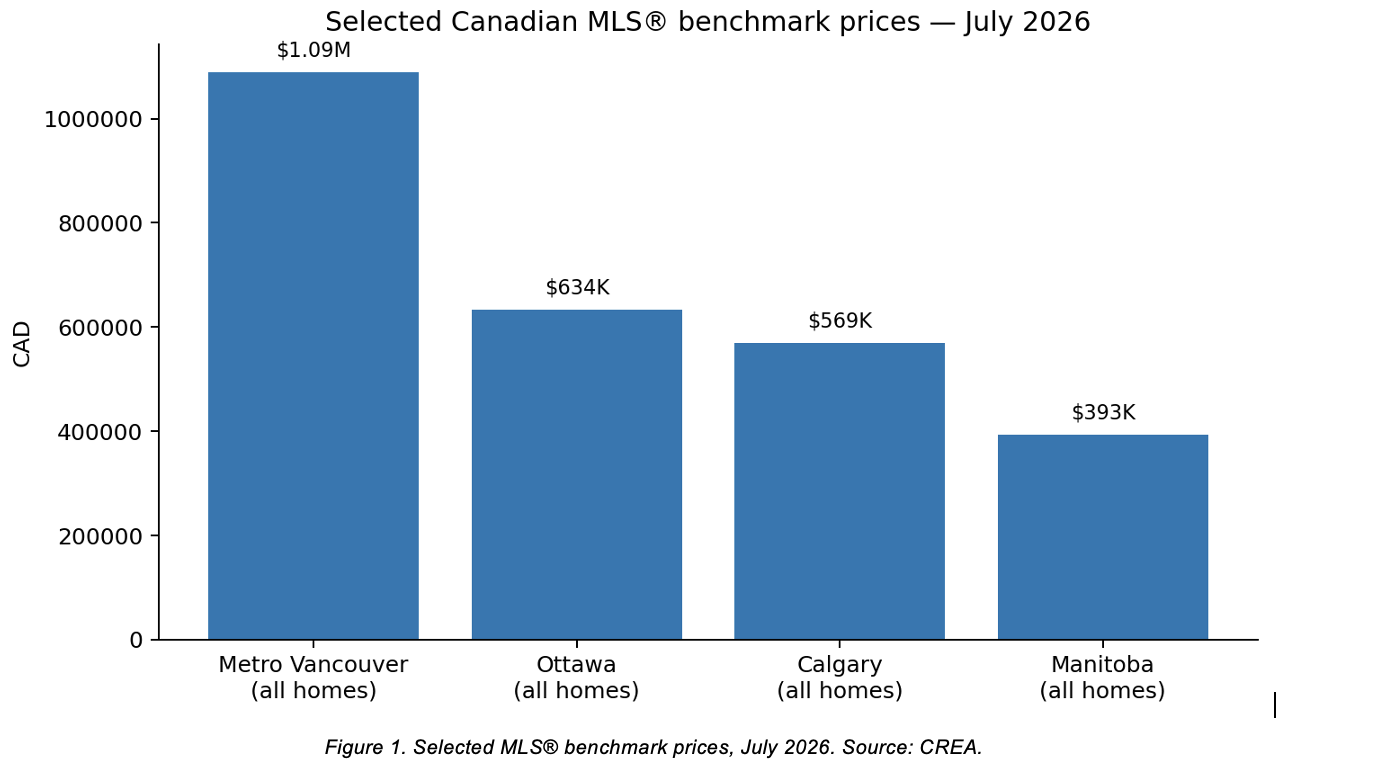
Regional price dispersion is substantial. Metro Vancouver’s composite benchmark was about CAD 1.089 million in July 2026, compared with CAD 634,000 in Ottawa and CAD 569,200 in Calgary. Manitoba’s provincial composite benchmark was CAD 392,900. Those figures illustrate why a CAD 600,000 budget can translate into very different property types, neighbourhood quality and rental strategies across the country.
In Toronto, the average selling price in July 2026 was just over CAD 1.0 million, while the median condominium-apartment price in the second quarter was CAD 541,000. Calgary’s apartment benchmark was CAD 297,600 in July, reflecting a much lower entry point but also a different supply-demand profile. A Homium shortlist should therefore compare both purchase price and the local market structure behind that price.
Buying as an investment: what Homium would analyse
For investment, Homium recommends testing three scenarios before making an offer: a conservative rent case, a normal operating case and an exit case. Gross yield alone is not enough. Condominium fees, property tax, insurance, maintenance, vacancy, property-management costs and financing can materially reduce net income. In a high-cost market, a lower-yield property may still be attractive if it has strong liquidity and long-term scarcity; in a lower-cost market, higher nominal yield can be offset by weaker resale demand or new supply.
A practical 2026 strategy is to favour properties that can serve more than one type of occupant: one- and two-bedroom units near employment nodes, transit, universities, hospitals or established mixed-use districts. For family purchases, low-rise homes and townhouses can offer more space, but the capital requirement and carrying costs are higher. New construction can provide modern specifications and warranty coverage, while resale homes often offer better visibility on the surrounding neighbourhood and immediate comparables.
Example investment screening framework
|
Item
|
Illustrative assumption
|
Why it matters
|
|
Purchase price
|
CAD 500,000
|
Defines equity and financing need
|
|
Gross monthly rent
|
CAD 2,600
|
Starting revenue assumption
|
|
Annual gross rent
|
CAD 31,200
|
6.24% gross yield before costs
|
|
Condo fees + tax + insurance
|
CAD 10,000/year
|
Reduces cash yield materially
|
|
Vacancy/maintenance reserve
|
5% of rent
|
Stress-tests operating risk
|
Property purchase, relocation and immigration status
Buying property and immigrating to Canada are separate legal processes. Ownership of a home does not, by itself, create permanent-resident status or a right to remain in Canada. In addition, the federal prohibition on certain residential purchases by non-Canadians remains in force until January 1, 2027, subject to statutory and regulatory exceptions. For example, some temporary residents and work-permit holders may qualify under prescribed conditions.
This is why status should be checked before property selection, not after an offer is signed. A newcomer should coordinate a real-estate professional with an immigration lawyer where needed, a mortgage specialist, a tax adviser and a closing lawyer/notary. Provincial rules may also add land-transfer taxes or additional non-resident taxes. Homium treats legal eligibility and total acquisition cost as part of the investment analysis rather than as administrative details.
A safer purchase process for newcomers
For most buyers, a disciplined purchase process is more valuable than trying to time the exact bottom of the market. Start by defining the city, tenure, budget and financing. Then establish a total-cost ceiling that includes closing costs and a contingency reserve. Compare recent sales, not only listing prices; review condominium documents where applicable; order a home inspection when appropriate; and model the monthly carrying cost at a higher interest rate than the initial quote.
For international buyers and newcomers, liquidity matters. Keeping a reserve after closing reduces the risk of being forced to sell during a weak market. Homium generally recommends avoiding a purchase that uses every available dollar for the down payment, particularly when the buyer’s employment or immigration situation is still evolving.
Homium recommendation
For a current inventory overview, review real estate in Canada on Homium and build a shortlist by city, property type and budget before comparing financing and legal eligibility.
Canada in 2026 offers a more balanced and more selective property environment than the rapid-growth years. That can be favourable for disciplined buyers: there is greater regional choice, more negotiating room in several large markets and a clearer distinction between properties that are genuinely scarce and those competing with new supply.
Homium can help structure the search around the buyer’s objective — relocation, long-term residence, rental income or capital preservation — and compare locations on price, legal eligibility, operating costs and exit liquidity. The starting point is the current selection of Homium Canada listings.
FAQ
Can a foreign buyer purchase residential property in Canada in 2026?
Not automatically. A federal prohibition applies to certain purchases by non-Canadians until January 1, 2027, with defined exceptions. Eligibility should be checked before making an offer.
Does buying a home help with Canadian permanent residence?
No. Property ownership and immigration status are separate. A home purchase does not itself grant permanent residence, a work permit or a right to stay in Canada.
Which Canadian market is best for investment?
There is no universal answer. Toronto and Vancouver offer deep markets but high entry prices; Calgary and parts of the Prairies offer lower entry costs but different supply and rental dynamics. The decision should be property-specific.
Is 2026 a good year to buy?
For qualified buyers with a multi-year horizon, softer conditions in several markets can improve selection and negotiating power. The key is to stress-test financing and avoid relying on short-term price appreciation.
What costs should be budgeted beyond the purchase price?
Depending on the province and property, buyers may face land-transfer taxes, legal fees, inspections, mortgage costs, property tax, insurance, condominium fees, maintenance and, in some cases, additional taxes for non-residents.
Data sources: CREA national and board statistics, July 2026; CMHC Summer 2026 Housing Market Outlook; Government of Canada / Justice Laws on the non-Canadian purchase prohibition.